Double anniversary in Bamberg
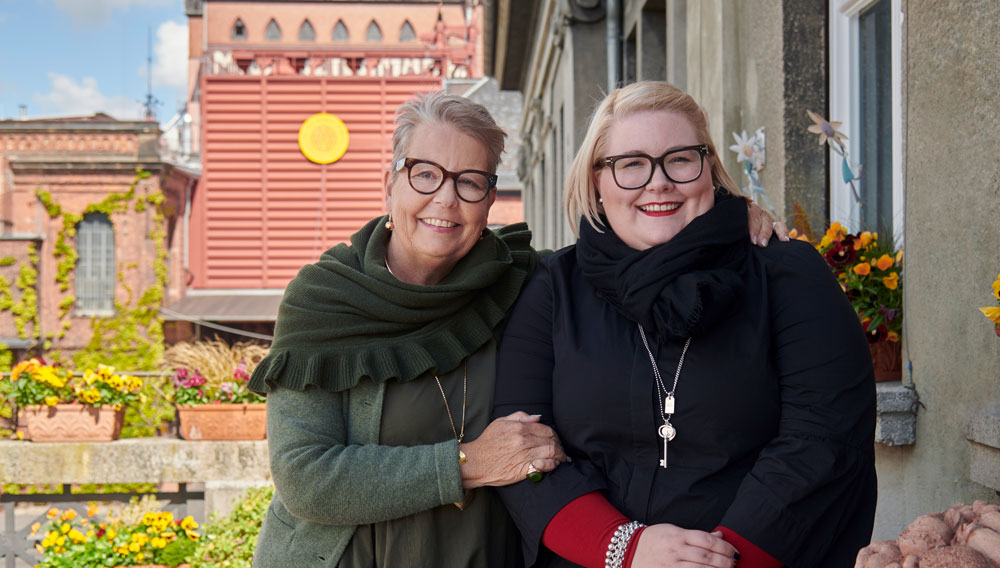
Women at the top | On October 1, 2025, family business Weyermann® Malz GmbH & Co. KG celebrated an unusual anniversary: Sabine Weyermann looked back on 40 years as its CEO, with her daughter Franziska Weyermann proud to mark 15 years working at the company. This event is an impressive example of successful female leadership in a branch of industry traditionally dominated by men. In a joint interview with BRAUWELT, Sabine and Franziska Weyermann tell us how they experience and carve out their role in the malting industry.
Your malthouse enjoys a long family tradition, one also dominated by men in the company. Sabine Weyermann, what was it like joining the company 40 years ago? And Franziska, what was it like for you 15 years back?
Sabine Weyermann: Thanks for your question – but may I first make a brief remark? Even if our malthouse, like so many companies of their day, was long managed by men, it was my great-grandmother Sabine Weyermann née Sippel – the wife of the company founder – who kept the company going on her own throughout the extremely challenging years of the First World War, showing remarkable strength and foresight in the process.
When I joined the company 40 years back, I was well prepared thanks to my studies at the TU Munich Weihenstephan. I had great plans to take the company further together with my father Heinz Weyermann and to learn from his experience. Unfortunately, things didn’t turn out that way and I suddenly found myself his successor. What really helped me at this stage in my life was the support I had from our workforce, who were always there to motivate me and develop my ideas further.
Franziska Weyermann: I had a smooth initiation into to the company, for by then I’d already watched my parents at work for over 30 years. I went to my first international craft beer fair in the USA when I was just five. I’m very grateful to my parents for adopting a policy of honesty and openness, with us always discussing both the ups and the downs. I had access to the firm from a young age; this also motivated me to successfully finish my degree course at Weihenstephan. Thanks to my parents’ role model, I never had the feeling that I was entering an industry dominated by men but a company where men and women worked on an equal footing and the strengths of both sides were emphasised.
Together you notch up 55 years of experience in the industry. How do the perspectives of two different generations complement one another, both strategically and in operative business?
Sabine Weyermann: Luckily, we share the same basic principles such as appreciation, honesty and competence and pursue a common strategic direction, namely that for us, the good of our customers always comes first. And yet sometimes the young revolutionary clashes with the traditionalist, causing a certain friction. These are the days that always help us to move further forward.
Franziska Weyermann: As our coach always says, every conflict always also ends in a rainbow!
What experience have you had as managing directors – and how do you specifically find the role of women at the top in a technical environment?
Sabine Weyermann: It’s always a big challenge when men and women live and work together, for men see the world differently. Men and women experience lots of things differently; it’s often the little things that then add up. Franziska and I are part of a well-functioning (female) network at and through Weyermann. This network is important to us and we make it stronger every single day.
Franziska Weyermann: For me, this feeling isn’t as intense because I’ve always had and still have a strong pioneer in my mother. My place in the company was ‘prepared’. However, I’m still learning how to fill this every single day. I feel a lot more for all those women who have to make their way all on their own.
For me, it was always normal to be one of few women. At secondary school, I was one of just six girls in my class; at university, there were only four of us. I wish this number would increase, though.
Which structural hurdles have you yourselves had to overcome – and what would you advise young women who want to start working in the brewing or malting industry today?
Sabine Weyermann: When I joined the management board, I was confronted with a structure that didn’t normally see women as leaders. This was a reflection of the times – and not just in our company. The notion that women were more likely to be found in the kitchen than at the office was deeply anchored in society. Thanks to my active lead, Franziska had a clear example of how things can also be done differently. Generally speaking, I’d advise young women to build up a good network and always be competent in what they do, combining this with plenty of charm and humour.
How has your approach as female executive influenced product innovations or strategic decisions?
Franziska Weyermann: The harmony between the technological vision of my father and the empathetic leadership of my mother has always allowed us to enjoy great proximity to the customer.
This has created a merge of technological excellence and dedication, one of the most outstanding characteristics of Weyermann. How we present ourselves and who we are are authentic – our private persona is the same as our public persona. There’s no difference between them and this is what customers appreciate about us.
How has the malting industry or how have the demands made of malthouses by breweries changed over the years?
Sabine Weyermann: Brewers are now far better qualified and see their supplier companies as reliable sparring partners. The world of craft brewers is marked by great diversity, paired with an impressive internationalism at Weyermann.
Brewers nowadays want to deal with people who are competent and appreciate the direct contact with their family maltster. They’re not just looking for specialist support but also for human solidarity.
Franziska Weyermann: Particularly in times where multinational concerns are dominant on both sides – breweries and malthouses – we see a special niche for a dialogue between family-run breweries and family-run malthouses. Here, we’re on an equal footing.
How are you addressing the lack of specialist workers and how are you getting youngsters interested in the malthouse?
Sabine Weyermann: We tackle the lack of specialist workers by providing a meaningful working environment. We believe it’s important that everyone knows what and how he or she can contribute to the success of our company. Here, we recruit able junior staff through a systematic training programme. We offer apprenticeships in 13 different skilled occupations, for instance.
Franziska Weyermann: Further training is just as important to us – and life is long! At our in-house academy, we support and encourage our employees’ further education requirements. I see this with my parents: they’re still eager for knowledge, they still want to learn new things and steadily move the (Weyermann) world forward. This sets a great example to us all.
How do you judge the current competitive situation on the malt market, both nationally and internationally?
Sabine Weyermann: National and international competition on the malt market is becoming increasingly challenging. This is why we consider it extremely important to score with consistent, outstanding quality.
Franziska Weyermann: Our family firm enables us to always be close to the customer, to know and respect their needs and wishes.
Sabine Weyermann: I’m sure that quality-oriented suppliers will shape the market.
Where’s the industry going in the next ten to 20 years? What are the biggest challenges and opportunities, especially with respect to the role of family businesses in the brewing and malting industries?
Sabine Weyermann: We’re seeing a growing tendency towards international companies and major concerns in the development of the brewing and malting industries. This is why family breweries feel all the better looked after by family malthouses, because this is where we encounter one another at eye level.
As a general rule, we can say that beer always sells.
Franziska Weyermann: The industry as a whole will also have to adapt to the coming generations. What are their drinking habits? What do young people find important? Here, you have to go with the times – and this is something Weyermann’s good at.
Many thanks for talking to us and all the best for the future!
The questions were asked by BRAUWELT editor-in-chief Dr. Lydia Junkersfeld.
Authors
Lydia Junkersfeld
Source
BRAUWELT International 6, 2025, page 332-334
Companies
- Mich. Weyermann® GmbH & Co. KG, Bamberg, Germany