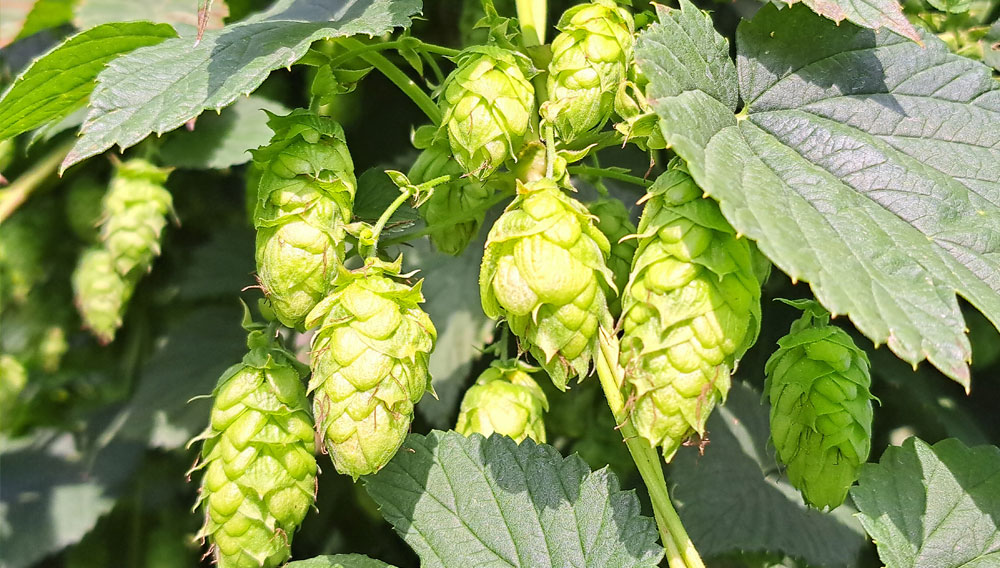
The hop market of the future
Hop strategy | Like the beer market, the hop market is currently in crisis. As beer consumption falls in Germany – and indeed throughout the rest of the world– so does the requirement for hops. This is contrary to expectation. How do hop sellers and hop traders thus reposition themselves in this environment so that they can look to the future with confidence? Strengthening this strategic focus, Hopsteiner recently appointed Florian Perschel as Commercial Director, bringing extensive international expertise in sales, business development and innovation to support the company’s customer-centric growth strategy. BRAUWELT talked to managing director Pascal Piroué and head of Supply Chain Martin Schöttl-Pichlmaier at Simon H. Steiner, Hopfen, GmbH, in Mainburg, Germany.
Mr Piroué, how is today’s hop market managing in view of the drop in beer consumption not just in Germany but also worldwide?
Pascal Piroué: The hop market has been facing a number of exceptional challenges over the past few years: on the one hand, there’s the physical global accumulation of hop products that isn’t diminishing, as for years now more alpha acid has been produced than needed. On the other, contracted volumes are putting pressure on the market, commissioned by breweries who forecast a stable or even increasing beer output above and beyond their actual requirement. The hops are stored with the sellers; they’ve been contractually sold but are only called off by the breweries when needed – which at the moment is not very often. This lies in miscalculations made during the post-Covid period, when it was assumed that beer sales would recover and return to their former levels. But exactly the opposite has happened: for 2025, we’ll see a global hectolitre output that’s at about the level of Covid year 2020 – with a further downwards trend expected. Preliminary contract quotas show that breweries relied on needing amounts that were sadly not realistic. The US craft beer segment, too, believed that volumes would again rise, yet requirements have steadily decreased over the past three years here as well, meaning that contracted hops remain in the warehouse. There are many reasons for this: changes in consumer behaviour, anti-alcohol campaigns run by the WHO and weak consumer buying power in some regions caused by inflation are just some of the factors that have led to the current situation.
Mr Schöttl-Pichlmaier, what does this mean for the hop trade? What are the particular challenges, also in cooperation with hop farmers and breweries, for example?
Martin Schöttl-Pichlmaier: This means that we’re more hesitant when it comes to purchasing and only buy the quantities we really need. We have to reduce acreage, but this measure hasn’t yet caught up with what’s actually happening on the market, so at the moment spot market hops are still being produced that are very difficult to sell. Here, the asking price for hops sold on the spot market is way below the variable costs of hop production. We’re trying to redeploy contracts between breweries as soon as hops are needed elsewhere. Where we don’t manage to do so, the hops remain in stock and we sometimes have to wait a very long time until they’re called off. It’s important to know that lots of breweries keep stocks that amount to several times their annual requirement. The reluctance to buy also affects processing companies who in future will have to reckon on lower throughputs; at the moment, later call-off of hop products is also increasing the need for cold storage capacity.
Piroué: Overcapacity, i.e. areas under hops that are no longer needed, must be reduced as quickly as possible. There’s no getting round this. I estimate that in Germany alone at least 3500 hectares need to be dug up to cut down on our annual overcapacity. And this doesn’t account for the warehouse stock accumulated over the last one to two years. On a global scale, at least 7000 hectares need to be cleared. The USA has already grubbed up a third of their hop fields since 2021 – but that’s not yet enough to balance out the global supply.
Schöttl-Pichlmaier: Here in Germany, we would’ve had to start clearing a couple of years ago but this wasn’t possible, as these areas of cultivation were bound by contract. Lots of contracts are now expiring and we can only now start digging fields up. This will be financially hard for the individual farmer, however. When fields are cleared, the balanced ratio between machine park and farming area or repayment of investments can be upset. There’s also the case of overclearance. Until existing stock has been reduced and there’s a demand for new produce, too much land has usually been taken out of production. Breweries therefore shouldn’t leave it too late to start thinking about follow-on contracts with adequate pricing for the supply chain. You can see that it’s extremely difficult to bring the hop and beer markets into line with one another.
Piroué: Switching over to new varieties also has an impact, so just considering acreage alone doesn’t go far enough. Therefore, we shouldn’t speak of cutting down on areas under hops but about adjusting the quantity produced to the demand for alpha acid. In doing so, we need to adjust to the ongoing slump in beer consumption. Here, it’s to be feared that not all participants throughout the value chain will stay on the market. With this, I don’t just mean hop farmers facing problems with succession – who are probably thinking about closing down anyway. At the moment, the specialists are also suffering, those who’ve invested and farm larger areas. And if they go, we’ll lose expertise!
Luckily, we currently have the impression that breweries are increasingly warming to new, higher-yield, more climate-stable varieties that also achieve better scores when it comes to sustainability. In the coming years, we here at Hopsteiner will be changing over to our new varieties on a large scale, hops whose genetics make them more heat-tolerant and allow them to cope with less water.
How significant is breeding – or, to be more specific, are your breeding activities for German and European hop-growing areas?
Piroué: Our hop breeding activities are the key to the future market success of our corporate group. Generally speaking, we want to update our hop portfolio to include marketable varieties that our expert team will monitor from breeding to cultivation, right into the world’s brewing kettles.
Schöttl-Pichlmaier: I’d even go as far as to say that this is absolutely necessary, for if there’s no more hop breeding in Germany, in the long term hop farming in our country may no longer be profitable. What’s more, farmers benefit from there being more than one breeder, as there’s a higher probability of a good variety being produced.
Piroué: In the USA, over 70% of varieties already come from the private sector. There may be countless state facilities in the countries of Europe; however, in many of these countries we’re not seeing the direction and market orientation of the USA, where breeding programmes are tailored to requirements and usually lead to immediate market success.
About 97% of hops are used in beer production. In view of the current situation, will this remain so?
Piroué: We’ve been making a great effort for some time now to also market hop products outside the brewing industry. Here, we’re talking about the use of hop extracts as preservatives, products that contain xanthohumol, hops in technical applications or – and we demonstrated this at drinktec with our LLZ hop oil – aromas made from hops suitable for application in the soft drinks or confectionery industry. This all calls for a considerable amount of time and expenditure to be invested in research projects and production equipment here at our plant. However, in return we’re hoping for a better creation of value than for our classic kettle products. Since our change in management a few months ago, we’ve strongly focussed on this approach because, like the breweries, we’re asking ourselves how we can diversify and which new products we can launch to market.
Schöttl-Pichlmaier: In this context, too, we’re not only investing in hops for classic application in the brewery, such as breeding our own bitter hop variant, but are also working on a variety rich in xanthohumol that we want to test on a larger scale in the coming year.
Which trends do you see emerging for hop products in the next ten years?
Piroué: Ten years is a long time, but fluid extracts will surely prove to be one innovative trend. These extracts are liquid, pourable – and thus easier to dose. Specific aromas or bitter substances concentrated in hop oil constitute another trend; these enable breweries to create their own aromatic compositions. This will also be a new challenge for us as a processor with new equipment but extremely good value creation.
How is Hopsteiner prepared to master the challenges of the coming decades and secure the future of hop farming in Germany?
Piroué: We increasingly rely on digitalisation in all areas and will further invest in hop breeding and product development in Germany. We’ve rejuvenated and adapted our staff; through our new structure, we’re concentrating even more on innovation and market proximity, also in customer relations. Take our customer and grower portals, for instance. In short, we want to continue to be the most agile and most state-of-the-art hop seller in Europe.
Then we wish you the very best of luck! And many thanks to you both for talking to us and for your enlightening insights into the hop market.
The interview was conducted by BRAUWELT editor-in-chief Dr. Lydia Junkersfeld.
Keywords
hops company portraits hop trade
Authors
Lydia Junkersfeld
Source
BRAUWELT International 4, 2026, page 184-186
Companies
- Simon H. Steiner Hopfen, GmbH, Mainburg, Germany