
Global Crop estimate 2026
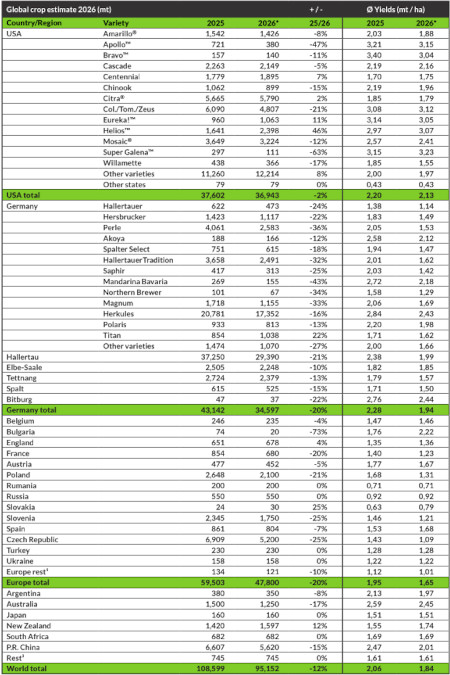
Hop market update | A heatwave that began in mid-June, with temperatures reaching up to 40.0°C, hot winds, and persistent drought significantly impacted hop development across Europe. In particular, hop gardens that failed to reach full trellis height lagged in growth and showed poor side-arm and cone development. With nearly 50 days above 30.0°C, a record level of heat stress was recorded.
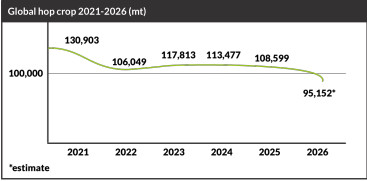
Only from the second half of August onwards did cooler temperatures and rainfall bring some relief. As a result, a very weak European hop crop with below-average alpha acid levels is expected.
Growing conditions in the United States were largely favorable throughout the season. Only young hop plantings showed uneven development. Water reserves remained sufficient through harvest. Spider mite pressure was locally higher in some areas, but with few exceptions it was successfully controlled. Rainfall shortly before harvest increased pressure from powdery mildew. Overall, an average hop crop is expected.
According to Pascal Piroué, Chairman of the Deutscher Hopfenwirtschaftsverband e. V., the weak 2026 European hop crop and lower alpha acid yields should not be mistaken for a solution to the current oversupply situation. While reduced production may help lower existing inventories, the global hop market continues to face significant challenges, including declining beer consumption in key markets and increasing climate-related risks. Piroué emphasized that irrigation remains essential for safeguarding future hop production and that the development and adoption of heat- and disease-resistant varieties will play an important role in improving resilience.

He also stressed the importance of reliable partnerships across the supply chain and a closer alignment of hop acreage with actual market demand. Furthermore, he warned that increasingly volatile yields driven by extreme weather events are reducing planning security for growers, merchants and processors alike. Despite the expected short crop, global hop availability remains generally sufficient, although shortages may occur for selected aroma and fine aroma varieties. Piroué also noted that the next 18 months will be crucial for restoring long-term market balance and ensuring sustainable economic conditions throughout the hop value chain.
Hopsteiner Newsletter September 2026 (PDF)