The determination of caffeine in non-alcoholic beverages
The global beverage market is experiencing an unprecedented expansion phase, driven largely by the growing demand for functional drinks and high-energy products. Within this scenario, two main categories dominate: soft drinks, which are typically water-based non-alcoholic beverages (often with added carbon dioxide), sweeteners, and flavorings, and energy drinks, a specific class of functional beverages specially formulated to stimulate physical and cognitive performance. In both these types of beverages, one of the most interesting ingredients remains caffeine (1,3,7-trimethylxanthine). From a chemical point of view, this alkaloid acts as a central nervous system stimulant, capable of reducing the perception of fatigue and improving mental clarity.
Given its nature, caffeine content is strictly regulated to ensure safe consumption: the European Food Safety Authority (EFSA) has established precise critical thresholds, setting a maximum safety limit of 400 mg/day for a healthy adult. For these reasons, highly accurate analytical monitoring is essential to ensure regulatory compliance, guarantee food safety, and certify the correct labeling of the finished product before it is placed on the market.
Bringing analysis to the line
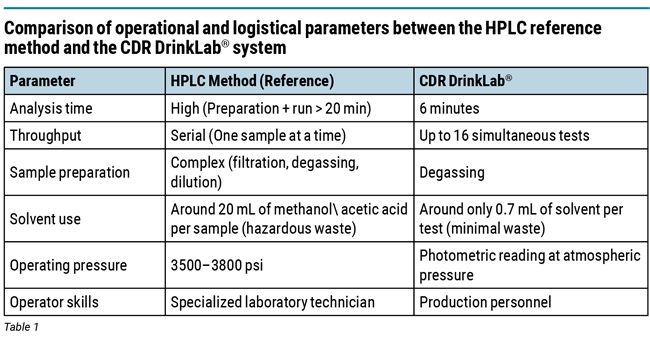
The quantitative determination of caffeine in soft drinks and energy drinks is traditionally conducted via direct UV-Vis spectrophotometry – heavily limited by the interference of colorants, organic acids, and phenolic compounds – or via high-performance liquid chromatography (HPLC), considered the gold standard. However, HPLC entails considerable labor: it requires extreme microfiltration, rigorous degassing to operate at high pressures (3500–3800 psi), the use of hazardous solvents (methanol and acetic acid), and highly specialized personnel, with analysis times exceeding 20 minutes per sample.
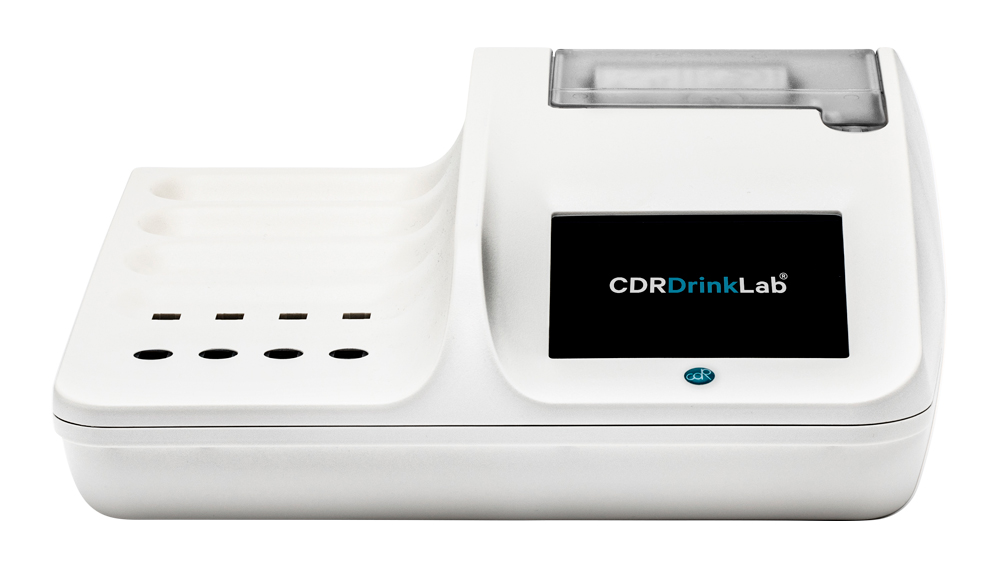
To overcome these operational constraints, the CDR DrinkLab® system offers an at-line approach based on ready-to-use reagents and photometric analysis. Sample preparation is reduced to rapid degassing, completely eliminating toxic solvents and reducing interferences for an even more reliable measurement. Capable of analyzing up to 16 samples simultaneously in just a few minutes, the system also allows production personnel to perform quality control directly on the line.
Matrix validation study
To validate the analytical performance of the CDR DrinkLab® system in caffeine quantification, a correlation study was conducted comparing the results with the official HPLC reference method. The primary objective was to test the reliability and robustness of the instrument by analyzing a highly heterogeneous panel of beverages, selected to evaluate the system’s response in the presence of particularly challenging matrix variables, such as high acidity, intense pigmentation, turbidity, and the interference of botanical extracts or nutritional additives.
The evaluation examined 10 distinct matrices, ranging from a zero-caffeine control to complex formulations such as nitro-dosed coffee, botanical energy drinks (Matcha, Yerba Mate), anthocyanin-rich juices, and amino acid-fortified functional beverages.
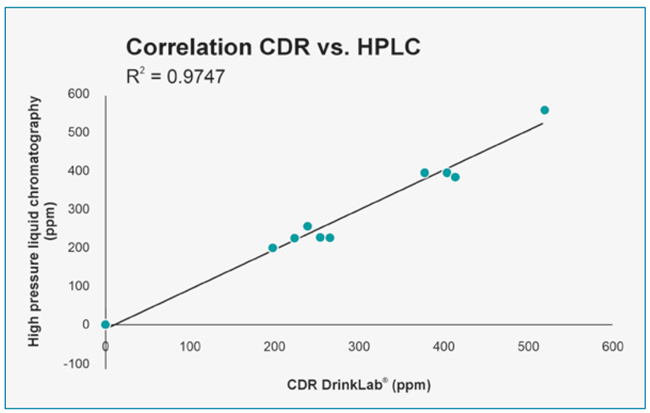
All described samples were analyzed in parallel to quantify caffeine content. Table 2 illustrates the direct comparison and correlation between the values obtained with the CDR DrinkLab® system and those measured by HPLC.
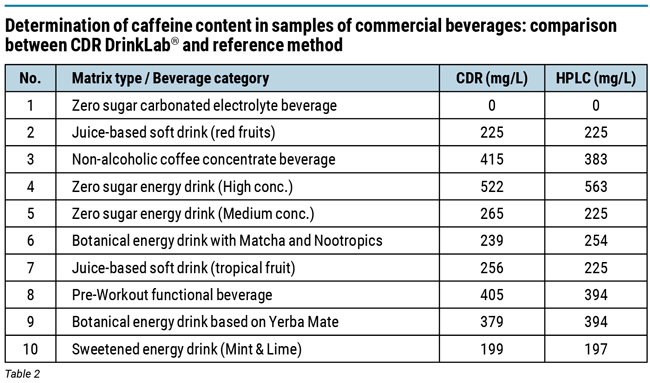
As highlighted by the data in the table, the linear correlation between the CDR DrinkLab® method and HPLC is excellent across the entire measurement range (up to concentrations exceeding 500 mg/L). The system confirms absolute specificity, demonstrated by the absence of false positives in the control sample (0 mg/L), and the absence of interferences due to the matrix effect. Even in the presence of complex interferents – such as dark pigments, high turbidity, or phenolic compounds derived from botanicals like Matcha and Yerba Mate – the values detected by the CDR correctly align with the chromatographic data, confirming the instrument as a solid, accurate, and rapid alternative for at-line quality control.
An integrated analytical platform
The CDR DrinkLab® system offers a rapid, accurate, and safe alternative to traditional HPLC for caffeine analysis. Its strong correlation with the reference method (R²=0.9747) and absence of matrix interferences make it perfectly validated for at-line process control and immediate batch release.
In conclusion, CDR DrinkLab® presents itself as an integrated analytical platform for multi-beverage plants, transferring to the non-alcoholic beverage sector the same operational efficiency and methodological solidity already widely consolidated by the CDR BeerLab® system in the brewing industry.
References
- Čižmárová, B., Kraus, V., Jr., & Birková, A. (2025). Caffeinated Beverages - Unveiling Their Impact on Human Health. Beverages, 11(1), 18. MDPI.
- Pradeep, S., Rameshaiah, G. N., Hadagali, A., & Chandraprasad, M. (2015). Caffeine Extraction and Characterization. International Journal of Current Research and Review (IJCRR), 7(9), 16–19.
- European Food Safety Authority (EFSA). (2015). Scientific Opinion on the safety of caffeine. EFSA Journal, 13(5), 4102.
- Fatima, R., & Madhavi, A. (2026). Validation and Determination of Caffeine Content in Energy Drinks by using HPLC Method. Sultan-Ul-Uloom College of Pharmacy (SlideShare).
- Brandes, H., & Cramer, H. Caffeinated Energy Drink Analysis by HPLC. Reporter US, Vol. 28.4, MilliporeSigma.
 |
Via degli artigiani 6 50055 Ginestra Fiorentina/IT www.cdrfoodlab.com |
Keywords
analytical methods non-alcoholic beverages measurement technology
Source
BRAUWELT International 5-6, 2026, page 246-247
Companies
- CDR Foodlab "Francesco Bonicolini", Florenz, Italy