
Rhizomes and beginnings
There are areas around the world set aside for agriculture that may look green and appealing to us with their nicely organized rows of plants yielding food or textiles for our consumption, but in Mother Nature’s eyes, they’re ugly and appalling. Why? Because life in all its seeming unruliness and wonderful variety, as it once existed on the land, has been driven out, carted off, sprayed away, mown down, burnt up or simply extinguished. All of this destructive effort is usually expended for the production of a single monocultural plant species in order to feed, clothe or fuel human endeavors with little thought given to the other countless species that depend upon the same land’s resources.
An abundance of evidence has been collected about biodiverse farming. These studies demonstrate that agrobiodiversity practices can indeed compete with industrial agriculture with regard to productivity. Moreover, they are also more robust and sustainable while also reducing risk to farmers. Industrial agricultural practices have ignored more traditional models that integrate greater biodiversity, though these methods have served farmers quite well since the dawn of agriculture.
Dissatisfied with the outcomes of industrialized methods and their effect on the environment, some farmers are beginning to see the errors in their ways, and it is dawning upon them that Mother Nature’s view of these so-called “green deserts” is far from rosy, since she likes flowers and the insects they encourage. Concerned citizens have decided to do something about it. Initiatives to enhance biodiversity in agriculture have now been implemented, and biodiversity is also being promoted on a public level as a means for adapting to our changing climate. For example, in the words of the European Commission, “Agriculture relies on biodiversity, and biodiversity relies on agriculture.” According to the European Environment Agency (EEA), “50% of all species in the EU rely upon on agricultural habitats.” Furthermore, the Commission states the following:
“The production of food and fiber depend upon a variety of ecosystem services, such as soil and water conservation, maintenance of soil fertility, resistance to pests and diseases, pollination of crops and diversity of genetic resources. A number of these services are also essential for mitigating and adapting to climate change and environmental pressures.”
Bats, bees and birds benefit
Farmers are thus changing their tune and embracing more traditional approaches again by allowing other species to share their fields, since ultimately, enhancing biodiversity often increases yield, soil health and simply creates a better world for all the species who must share the planet. Plus, pesticides, some of which act as neurotoxins, have been linked to conditions like Parkinson’s disease.
A less enlightened farmer often works with monocultures, does not rotate crops properly and overuses and misuses fertilizers and pesticides. Pests are often in a yin-yang relationship with predators. If the predators are eliminated, then the pests flourish. Farmers must then come in with heavy pesticide usage to combat pests, which often kills key pollinators, like bees, and insectivorous bats and birds, which farmers also depend upon for cultivating their crops. This is just one example how a vicious cycle of destruction and desolation can result from diminishing biodiversity. Studies have shown that ecosystem services, especially pest consumption, provided by insectivorous bats, birds and other species are a crucial but frequently underappreciated economic benefit of biodiversity.
In the past, farmers knew that strategically growing certain plants in close proximity, i.e., companion planting, was highly advantageous, since it increased yield, imparted better pest resistance and enhanced soil conditions. One example of how beneficial plants are used in agronomical practice can be found in viniculture. Rose bushes have been planted at the ends of rows and around vineyards for centuries. Their flowers provide not only color and beauty but also shelter for beneficial insects, while their thorns effectively mark row boundaries. Moreover, roses also serve the same purpose as a canary in a coal mine, i.e., as a “pest buffer” for aphids and also as an early warning system for fungal diseases such, as rot and powdery mildew. Roses are generally more susceptible to these afflictions than the grape vines, so they serve as a helpful visual warning system, allowing growers to implement the appropriate measures in a timely manner.
Eichelberg Biodiversity Site
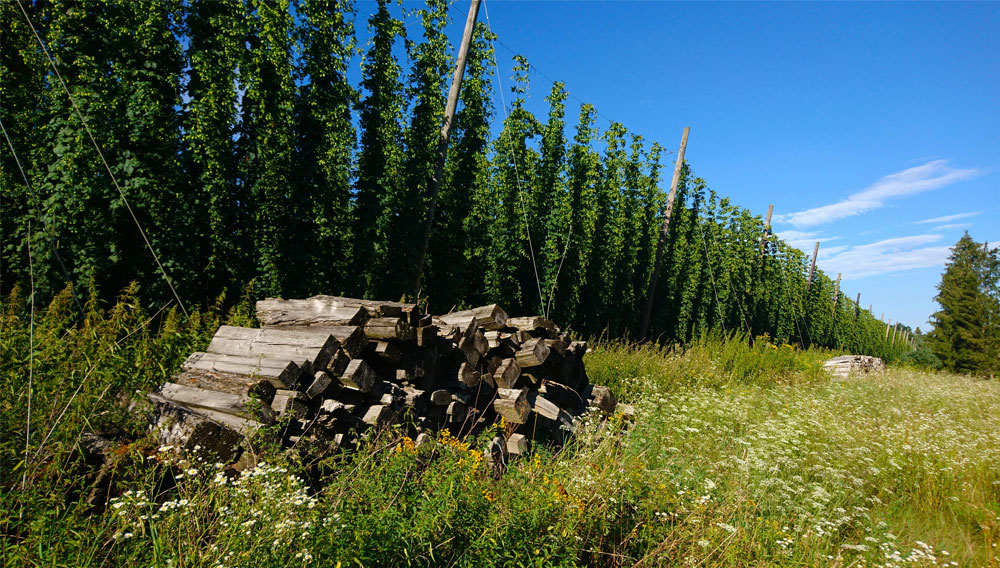
Under the authors’ very noses, there is, in fact, a site in the Hallertau that has been dedicated to promoting biodiversity in hop cultivation for some years now. The Eichelberg Biodiversity Site is a collaboration between the Hüll Hop Research Center and the Interessengemeinschaft Qualitätshopfen Niederlauterbach e.V. (IGN). The objective of the project is to demonstrate that economically successful hop cultivation and biodiversity are not mutually exclusive but rather that they can coexist quite agreeably. In fact, diverse ecosystems ensure the productivity of high-quality hop fields, while the surrounding arable lands and forest areas also benefit. The practical implementation of the concept has been in development since 2021 and includes measures to promote biodiversity in and around hop fields.
Habitats meeting the various requirements for native species have been created. The concept of flagship species in hop cultivation is intended to promote biodiversity in hop fields and to make success tangible. The species selected as part of this project are rather rare but typically occupy habitats in and around hop fields in the Hallertau. The flagship species of the project include the woodlark, the partridge, the tree sparrow and other species. Ant lions, wild bees, grasshoppers and sand racers are encouraged through the formation of piles of sand. A solar pond also provides a habitat and a refuge for other insect species. A themed trail “Hopfen und Artenvielfalt” (“Hops and Biodiversity”) was established in 2023 at the Eichelberg Biodiversity Site in cooperation with the AELF Pfaffenhofen/Ingolstadt, the Landesbund für Vogel- und Naturschutz in Bayern e.V. (LBV – Bavarian Organization for Bird and Nature Conservation) and the regional Nature Conservation Agency. It comprises 16 information boards along a 2.5 km route through an area under hop cultivation near Eichelberg.
Experimental trials conducted at the site on the environmentally-friendly regulation of the two-spotted spider mite through the application of predatory mites in hop cultivation have yielded promising results. These efforts have increased farmers’ knowledge and understanding of pest control in hop farming, so that in the future, they can be applied efficiently, economically and successfully on hop farms throughout the Hallertau.
Such projects prove that through the cooperation and innovation of farmers, organizations promoting nature conservation, and research institutions, sustainability and biodiversity can be reconciled with the economic goals of agriculture and industry.
As always, we’d like to hear what you think! Write to us with your thoughts, observations and/or opinions at .
Keywords
raw materials sustainability agriculture hop cultivation biodiversity
Authors
Nancy McGreger, Christopher McGreger
Source
BRAUWELT International 3, 2026, page 127-128
Companies
- McGreger Translations, Freising, Germany