
Paddy goes abroad
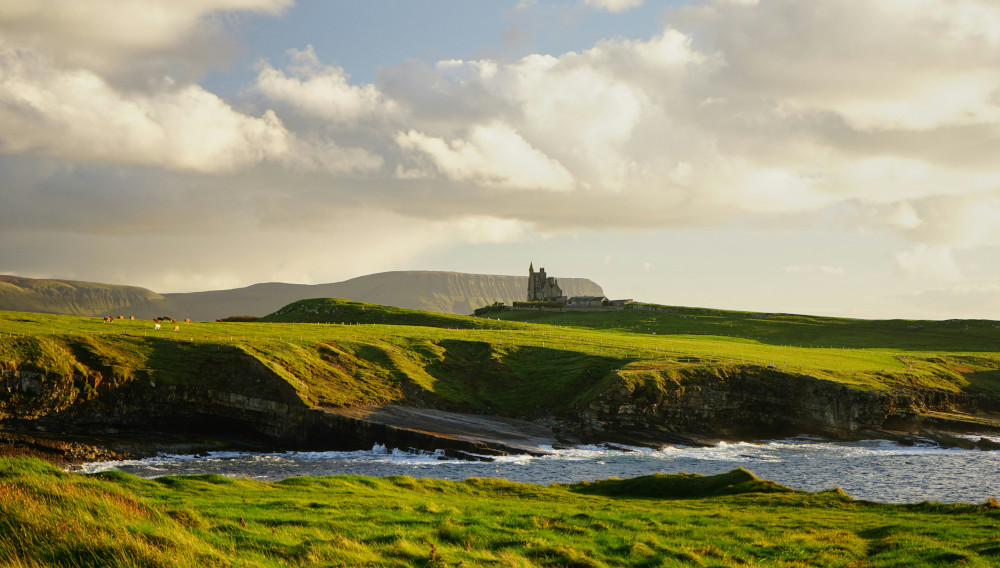
There is a diminutive, starkly beautiful island on the edge of the sea, or the Western Ocean as it is called by the island’s inhabitants. This island nation is home to a remarkable culture, and those at home and in its diaspora have recently raised a glass to commemorate their own ‘apostle’ on his feast day, known to them as Pádraig. He happened to have been born on another, larger island to the east named Britannia by the Romans who’d settled part of it. Towards the end of Roman rule there, this young man was taken by raiders from his parents’ villa and sold into slavery. However, life had other plans for him, and he made it back home, where he was subsequently educated as a bishop. And yet, he felt the need to return to the island of his bondage as a Christian missionary, where he could preach the Gospel to the natives. They would eventually come to honor him as the patron saint of Éire, or Ireland as it is known in English.
For anyone who has watched the seabirds wheeling on the sea spray-soaked air currents above the white-capped swells at the Cliffs of Moher or Sliabh Liag, heard the forlorn longing of a uilleann pipe accompanying guitar, fiddle, bosca ceoil (button accordian) and bodhrán (drum) in Lisdoonvarna, explored the lunar landscape of the Burren or read the prose and poetry of Swift, Keats, Wilde, Stoker, Joyce, Heaney, Shaw, O’Brien (there are several), Behan, Beckett, MacGowan – the list goes on – understands why this island has had such an outsized influence on Western Culture. The trials, tribulations and tragedy of its history fuel the turbulent hearts and rare intellects of these islanders’ art and literature, in part because the majority live in a diaspora that longs to return to the lush, green fields encircled by cruel, tempestuous seas to once again find a cozy spot in an inviting pub, where the beer is dark and the mood is anything but.
Hello, darkness my old friend
Given the high calcium and magnesium content of Irish water that’s paired with carbonate and bicarbonate ions from the limestone it passes through, one would classify the water over most of the island as hard or very hard. Since water is the primary ingredient in beer, the mineral content interests us as brewers. A common characteristic of the grist for brewing beers in regions with this kind of water is to utilize dark grains, and by that, we mean those subjected to the Maillard reactions and perhaps to a bit of caramelization, as well. The darker grains were observed to facilitate mash conversion by brewers of ages past and consequently became customary in the grist of limestone waters. In the absence of water treatment, it is thus no accident that the historical beers of London, Munich and Ireland were all dark. The Maillard reactions produce acidic substances, among them melanoidins, which counteract the acid-neutralizing minerals in carbonate waters.
Porters Pound Porter
The beer fueling the beating heart of industrializing Britain was named after those who carried goods around the English metropolis situated on the Thames. One can think of them as the Sherpas of the Industrial Revolution. One type of smoked ‘brown malt’ was used to make porter in the 18th century and into the latter half of the 19th century. The malt was still diastatic, like Munich malt, and was much cheaper than coke-kilned pale malt. The inhabitants of London, the largest city in the world at the time, drank highly hopped, blended beer, about 1/4 to 1/3 ‘keeping porter’ (mature) and 2/3 to 3/4 ‘running porter’ (young), some of it from wooden vats so vast, that they could hold over 30,000 hl. The heavy-handed hopping kept most of the bacterial activity down, meaning that after Saccharomyces had done its due diligence, Brettanomyces inherited the keys to the kingdom. Therefore, porter at this point in history somewhat resembled the tart, wine-like reds and browns of Flanders, brewed there since at least the 17th century. These Belgian styles are still blended in a similar manner from beers aging in forests of foeders or aging tanks. In the late 19th century, the ‘brown malt’ for brewing London porter gave way to a combination of diastatic base malt (pale) and specialty malts (brown and black).
Given that top fermentation was also typical across almost all of Europe and the British Isles until relatively recently and is still the norm in a number of regions, the far-flung islands of the West were never really exposed to Continental methods of brewing until the latter half of the 20th century.
The malt bed of Cuchulainn
Back on the Emerald Isle, 18th century brewers not only faced brewing liquor with a similar mineral content, i.e., with a high carbonate hardness, they were also confronted with high excise taxes on coal. Expensive coke for kilning malt allowed for tighter temperature control, a lighter color and a very agreeable flavor. Nevertheless, the smokier and darker malts kilned over wood were much cheaper and could be employed for making more reasonably priced beers for working class drinkers. So, darker grains seemed to be the best solution for cutting costs. Given that breweries were also taxed on the amount of malt they used, brewers experimented with unmalted grains as well, including with additions of lightly kilned and highly kilned raw barley combined with diastatic malt. (A silkiness on the palate results from some lightly kilned, unmalted barley in the grist.)
Likewise, brewers also divided the wort during lautering, producing a more expensive beer from the first wort and a less expensive one from the sparged wort. The least expensive porter brewed in Ireland came to be known as ‘plain’ and must’ve been quite reasonably priced, since even writer Flann O’Brien could afford it, as attested in his poem The Workman's Friend, which begins:
When things go wrong and will not come right,
Though you do the best you can,
When life looks black as the hour of night
– A pint of plain is your only man.
However, a stronger porter, both in flavor and alcohol content, became known as ‘stout porter’ and later just as ‘stout,’ brewed in strengths of single, double and extra. Stout has an extremely dark ruby red color (black to a casual observer) and exhibits a pleasant roastiness, smooth mouthfeel, bitter hoppiness and a tart, refreshing finish.
Cross the wild Atlantic
When the authors were in Ireland prior to it joining the EU, there were three stouts available in pubs. One drank whatever was on tap in that particular region, be it Murphy’s, Beamish or Guinness. We have fond memories of all three. Surprisingly, a fellow pub-goer on the west coast swore that the Guinness was better there than in Dublin, due to the extended maturation it got traveling the breadth of the island. This sounds like a tall tale, but one should never underestimate the wisdom one can learn from patrons in a pub, especially in Ireland.
Artist and marketing mastermind John Gilroy created the beloved and timeless Guinness ads featuring the hapless zookeeper whose animals kept stealing his pint of stout starting in 1929. The slogans ‘Lovely Day for a Guinness,’ ‘Guinness is Good for You,’ ‘My goodness! My Guinness!’ and ‘Guinness for Strength’ ran for 30 years and featured the ‘Guinness Menagerie’ of which the toucan became the most famous. Actor Peter O’Toole once said, “My favorite food from my homeland is Guinness. My second choice in Guinness. My third choice – would have to be Guinness.” So anyway, many years on, much has changed for better or worse in Ireland; however, it is estimated that on March 17th alone, i.e., on St. Patrick’s Day, there were approximately 13 million pints of stout, mostly Guinness, drunk around the world. This is something we can get behind. So, dear readers, we hope that you had a happy St. Patrick’s Day and will carry the blessings of this verdant island with you wherever you may be for the rest of the year.
Keywords
beers of the world beer culture Ireland beer
Authors
Christopher McGreger, Nancy McGreger
Source
BRAUWELT International 2026