
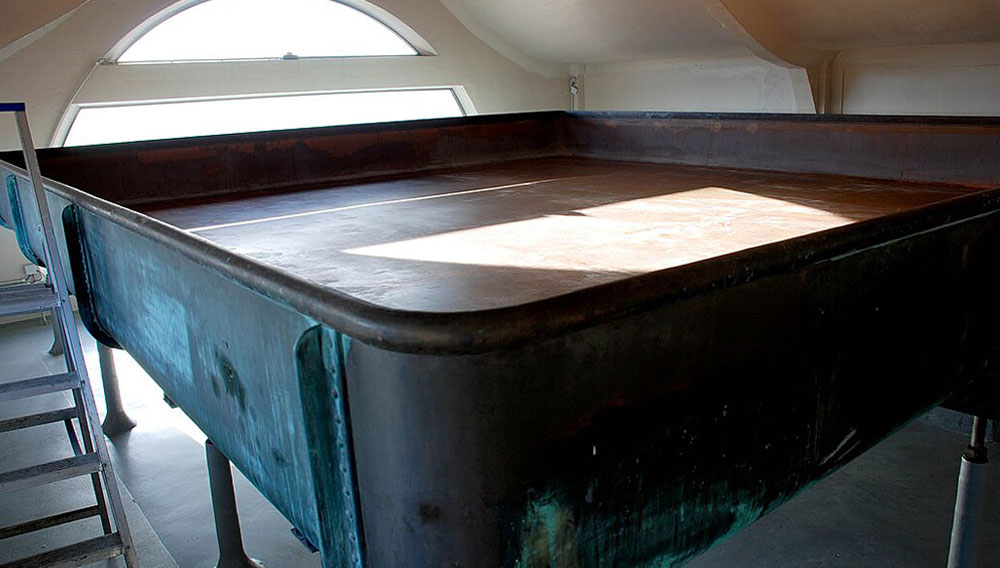
Ships passing in and out of the dim veil of history
Some craft brewers have attempted to resurrect coolships or ‘flat coolers’ in beer production. However, their true purpose among craft brewers has largely been misconstrued. It is a vessel seldom encountered in a modern brewery, though it can still be quite expedient if utilized correctly. And yet the only real objections to their implementation are that a brewery cannot recover as much of the energy it has already suffused into the production process, and a proper coolship also happens to take up a lot of space. Modern technology in the form of post-whirlpool evaporation has even attempted to emulate their beneficial effects on the wort prior to chilling.
Use of coolships throughout brewing history
Coolships in Medieval and Early Modern Europe were made of wood, and brewing operations at that time were quite different from those we are familiar with today. Though the mash was heated, a means for rapidly bringing down the temperature of an entire batch of wort from near 100°C would not have been necessary before the discovery of hop isomerization through boiling or when brewers only boiled a small portion of the mash or wort with hops. The wort for Gose, one of Germany’s oldest documented beer styles, was cooled using so-called ‘Kellerlöpen’, described as wooden vats or troughs. The depth of the wort would have been very shallow, closer to 5 cm and no more than 10 cm. This is because wood does not conduct heat very well, and a brisk cooling effect thus required very shallow wort.
Once coolships began to be made of metal, the height of the wort in them could be a bit deeper but not by much. When coupled with a cooler, like a Baudelot chiller, a metal coolship became an essential piece of brewing equipment. Due to its high heat conductivity, copper was the most preferable material for brewhouse equipment, but iron was also employed. Combined with chillers, their role as cooling equipment became less comprehensive, though that initial drop in temperature was still essential, since the Maillard reactions, Strecker degradation, etc. ceased upon entering the coolship. Thus, the thermal stress on the wort was very low. The coolship fulfilled a number of essential roles in brewing, and to accomplish these objectives, it was only filled to a depth of 15 to 20 cm, or at most 25 cm. Coolships were common in Central European breweries even into the 1960s. The temperature of the wort pumped into a coolship plummeted to 70–75°C, increasing the original gravity of a 12% wort by 0.6–0.7%. If wort were produced in summer, it usually remained in the coolship until it reached about 50–70°C. At this point it would be cooled by a downstream chiller. In winter, the wort could be left in the coolship overnight to cool down completely, to around 10–14°C. Prior to the advent of refrigeration, this is one reason that brewing was limited to the period between the Feasts of St. Michael and St. George.
Functions of coolships
One concern brewers have with coolships is that they think their wort will become contaminated by the wild beasts of the air. This is not the case, given that certain criteria are met. Care should be taken that the ventilation in the room containing the coolship flows properly from the bottom to the top and out. When the steam rising from the surface of the wort to the louvered windows above forms condensate, the vaulted ceiling should be so designed that it allows the liquid to run down to the walls and not drip back into the wort. The coolship and the piping leading away from the vessel and into the fermentation cellar, should be very clean and the pitching yeast vital and present in sufficient numbers to effect a rapid onset of fermentation. If a brimming pail of healthy, freshly harvested yeast is pitched into aerated wort immediately downstream from the coolship and chiller, then the limited number of bacteria floating in on the air and into the wort do not affect beer quality, as they do not comprise wort/beer spoilers in sufficient numbers to do any harm. The risk of contamination with airborne microbes was investigated in the late 19th century. Results showed that the risk was, in fact, quite low, as long as evaporation of the wort was taking place. Most microbial contamination was found to originate from biofilms between the coolship and the fermentation cellar.
So, coolships are actually sedimentation vessels for hot break material, which also allow – due to their low wort depth and the temperatures at that point in the process – undesirable volatiles to be driven out through evaporation even though the boil has been halted. Back when coolships were common on the Continent, brewers even figured out how to induce a considerable portion of the cold break material to sediment out as well, through ‘Aufkrücken’, as it is known in German, by gently agitating the wort in the coolship with a crutch-like tool when it had reached between 50 and 60°C. After this agitation step, as the hot break settled out once more, it would also take 30 to 40% of the cold break with it. This was considered necessary to produce high quality beer.
Coolships thus combine certain functions of the following vessels:
- Whirlpool, centrifuge or decanter (removal of hot break formed during the boil);
- thin-film evaporator or wort stripper (post-boil evaporation of undesirable volatiles, e.g., DMS, Strecker aldehydes, etc.);
- flotation tank (removal of cold break formed between 55°C and 70°C).
Anyone familiar with the traditional use of coolships in brewing must be puzzled by the deep, bathtub-shaped ‘craft’ coolships one sees nowadays. These fulfill hardly any of the goals of such vessels and can be more favorably compared to an open fermentation tank. Perhaps, they should be dubbed ‘tub coolers’ instead because they’re not flat. The wort is deep, cooling and evaporation are slow, undesirable volatiles are not driven out, sedimentation takes much longer, and few beneficial processes are going on in them. Moreover, should one want to bring about spontaneous fermentation, the inoculation surface area for microbes is much smaller.
Speaking of which, famous among connoisseurs are the excellent beers of the Zenne River Valley, known as lambic, a beer which serves as a base for a number of fascinating products, including geuze, kriek and frambozenbier (in their Flemish spellings). Lambic is prized for its subtle yet intriguing complexity and white wine-like character. With a high percentage of raw wheat in the grist and ‘turbid mashing’ methods, the brewers producing these beers intentionally prepare wort that is more palatable to a wider range of microbes than do brewers of modern ales and lagers, who cater to pure cultures of brewers’ yeasts. One might say that lambic is, in part, mashed with bacterial enzymes in the fermentation cellar. Though most of the regional variation in spontaneously fermented beers is due to the microbes in the air captured by the coolship, the air contains few yeasts relevant for wort fermentation; these come mainly from wood, i.e., from condensate drippage above the coolship and, of course, from barrels.
Needless to say, whatever one’s brewing process or wherever one’s microbes originate – pure cultures, wood and/or the air – coolships continue to be relevant and can be used to meet a number of requirements in beer production.
We’d like to hear what you think! Write to us with your thoughts, observations and/or opinions at .
Keywords
fermentation history brewery equipment
Authors
Nancy McGreger, Christopher McGreger
Source
BRAUWELT International 6, 2025, page 342-343
Companies
- McGreger Translations, Freising, Germany