
Culture blossomed from agriculture
For millennia, humans have been turning long chains of insoluble starch derived from grain into a beverage possessing some degree of microbiological stability. So, for a very long time and for much of humanity, this beverage has been a safe source for important nutrients and has likewise served as an agreeable means of social cohesion. The fact that we used our gray matter to figure this out when we knew nothing of biochemistry or microbiology speaks to human ingenuity and is addressed by Richard Wrangham in his book “Catching Fire: How Cooking Made Us Human”.
The story is by now well known: After the end of the last Ice Age, around 12,000 years ago, humans in the area now known as the Fertile Crescent in West Asia began exploiting and – quite unknowingly – domesticating the self-fertilizing grasses that grew wild in the area, ancestors to our modern cereal grains, wheat and barley. Through trial and error, numerous advances in technology, refinement and over many thousands of years, farming for the purpose of grain cultivation to produce bread and beer developed.
It is noteworthy that Karaca Dağ, an extinct volcano in southeastern Turkey, forms a natural wedge dividing the drainage basins of the Tigris and Euphrates rivers, which, though close together here, only meet much farther south at the Persian Gulf. And it is upon the slopes of these highlands that the first grain, einkorn wheat, was domesticated, possibly for the purpose of brewing beer. Where the rivers join in the south is where the first production breweries arose. Some of humanity’s most significant triumphs, failures and innovations as well as many of its most beloved myths and legends emerged from within these alluvial basins: the founding of the first cities, crop irrigation, sexagesimal clocks and geometry, the Epic of Gilgamesh, the Enuma Elish (Creation), the Epic of Atra-Hasis (the first version of the Flood), Sargon of Akkad, Nineveh, Babylon and Abraham from Ur of the Chaldeans. This region has given us so much – and may yet have further wisdom to impart to us.
Aqua est vita
These two rivers form what has been referred to as the Cradle of Civilization. However, as mentioned, agricultural practices first developed well north of the Persian Gulf, that is, across the Fertile Crescent. Sedentism crept into these populations and saw them discovering how to alter the landscape to favor higher agricultural yields. These advances in farming moved downriver from the areas where grain had first been domesticated. A number of settlements that would become city-states formed in the south between the two rivers at the northeastern end of the Gulf.
Eons prior to human settlement of the region, the Euphrates actually flowed into the Mediterranean, but afterwards gradually changed its course. Once the Ice Age ended, the Persian Gulf filled, and finally, by the fourth millennium BCE, the Tigris and Euphrates joined further north than they do today and flowed down the spine of the river basin. Due to the sediment transported by the river, over time, by the beginning of the second millennium BCE the two rivers spread apart into separate channels and were displaced outward from their central axis. The Tigris moved east and the Euphrates west as the fan spread outwards towards their modern watercourses, only to meet much further south, near the head of the Gulf, which at that time was also farther inland.
The lands between the rivers
This gradual fanning out of the two watercourses away from each other resulted in rich alluvial soil being laid down between them. Civilization – or life in cities – began on these soils, named Mesopotamia (“between the rivers”) by the Greeks. The sites of ancient settlements can also be found on abandoned courses of the Euphrates and Tigris. Where the rivers finally joined in the deep south extensive marshes and grasslands proliferated, a veritable Eden one might say (which is where we get the word).
Few realize how pivotal these first civilizations were to humanity’s subsequent development. Famous urban sites like Eridu, Lagash, Ur and the greatest city of them all, Uruk, whose patron goddess was Innana (Ishtar) have disappeared in the mists of time. In their heyday, surrounding these cities were irrigated fields, producing grain yields to rival those of the modern world. These fed the many thousands of inhabitants living in the narrow, labyrinthine streets of these first urban settlements where among numerous other innovations, the first production breweries were established.
Beer – the muse of Mesopotamia
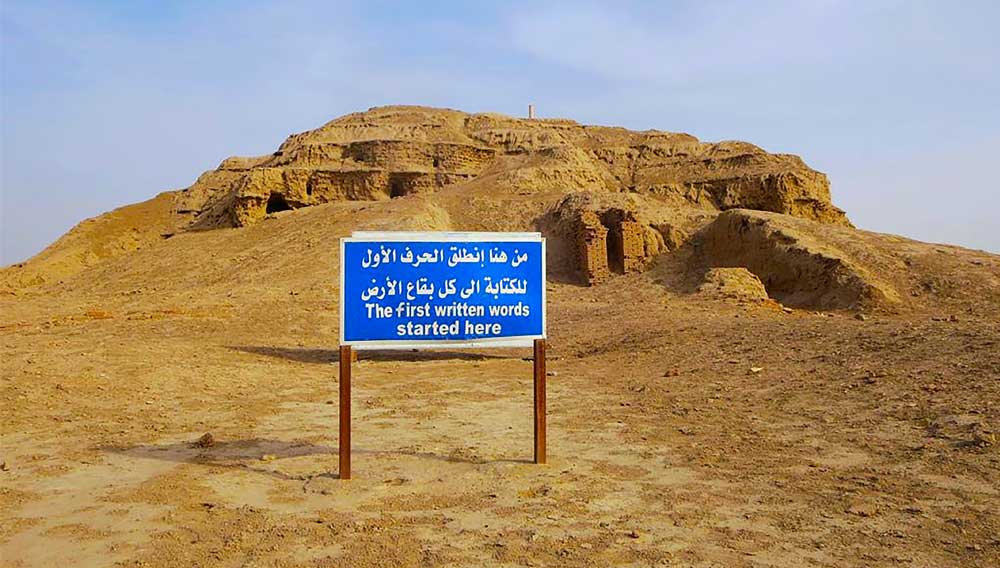
The Greeks not only named the region at a much later point in history, but they also claimed that wine served as the muse for Greek poets, such as Homer. Given the status of beer in Mesopotamia, I think we can safely say, that it served as their muse, since writing in cuneiform would have to be chief among the many inventions originating from between the rivers. Writing appeared a little before 3000 BCE, a remarkable feat that was originally developed only for accounting purposes to record grain, labor, water rights and, of course, beer volumes – all of which led to the first bureaucracy. However, as boring as that sounds, writing also eventually gave rise to the world’s first literature, in which the exploits of Gilgamesh, the Flood narrative of Atra-Hasis, and the creation myth Enuma Elish were recounted, among many others. Drinking songs sung at social gatherings were also recorded in cuneiform, along with hymns of praise to the Sumerian goddess of beer. The fact that we have this fleeting glimpse into antiquity gifted to us by these earliest scribes still boggles the mind, who transport us back: ‘…to a far off day, on a far off night, in a far off time, in Uruk…’ This excerpt from the Epic of Gilgamesh evokes the ancient city at its zenith. It was ringed by kilometers of walls, built by the semi-divine King himself, and dotted with blue-glazed tiles, gardens and ziggurats.
In the epic, Gilgamesh was propelled by his best friend’s death on an odyssey to seek eternal life. Given that the new cinematic version of Homer’s Odyssey is in theaters, one is reminded that the Epic of Gilgamesh is, in fact, many centuries older than Homer’s writings and heavily influenced the narrative of the cunning yet restless Mediterranean hero.
Uruk is now known as Warka, and several thousand years after its founding, it ultimately fell into neglect, becoming first a Persian frontier outpost before it was finally abandoned altogether after the Arab Conquest of Persia, around 700 CE. Its soil was all but spent, and it has since crumbled into virtual obscurity.
A distant mirror?
Since the founding of these first cities humans have appropriated over half of the Earth’s surface for farms and urban areas, and the destruction of natural habitats is the primary reason for recent declines in global biodiversity. Looking back at these sites in Lower Mesopotamia, taking in their dry, desolate and deserted nature, one would think that they are practically uninhabitable today. The rich alluvial soil is gone, and many of the extensive marshes have been drained. All that is left is a scorched, lunar-like landscape with a few scattered ruins of once stunning cities, which for the most part are now only apparent as collections of crumbling bricks.
There is perhaps a lesson to be considered here. For millennia, Lower Mesopotamia supported vibrant cities attracting thousands of city-dwellers who thrived and produced huge amounts of grain that fed and quenched the thirst of its large urban populations with bread and beer. And now it is a scorched landscape almost devoid of life. Hopefully, examples like this one will spur our modern beer-drinking civilizations on to find their muse and develop even more inventive and innovative ways to reliably sustain humanity – much more sustainably.
We’d like to hear what you think! Write to us with your thoughts, observations and/or opinions at .
Keywords
history raw materials sustainability brewing agriculture
Authors
Christopher McGreger, Nancy McGreger
Source
BRAUWELT International 4, 2026, page 217-218
Companies
- McGreger Translations, Freising, Germany